

Modular Mezzanine vs. Building an Addition: What Actually Costs Less in 2026?
Expanding a facility is rarely as straightforward as simply adding more square footage. When warehouses become overcrowded, or production teams outgrow their work areas, leaders must consider how much additional capacity they need, how quickly they need it, and what the expansion will cost beyond the construction budget. In 2026, rising construction costs, lengthy project timelines, limited available land, and disruptions from major construction projects are prompting facility leaders to rethink their expansion strategies.
Modular and prefabricated mezzanine systems allow businesses to create usable space by maximizing vertical capacity that would otherwise go unused. However, a mezzanine may not be suitable for every operation. An addition might be a better option when an organization requires significant new floor space, large equipment, or expanded infrastructure.
Instead of investing in larger buildings, many manufacturers are investing in warehouse space optimization, making better use of every cubic foot through vertical storage solutions, structural mezzanines, and high-density racking systems. The objective is to create more storage, increase capacity, improve workflow, and support future growth without the cost and disruption of new construction. This strategy can deliver significant value, but only when it is planned around the operation rather than the available space.
Do You Actually Need More Building?
Before approving an expansion project, facility leaders should assess the business’s actual capacity needs. If the goal is to enhance warehouse storage, inventory staging, production support, light manufacturing, assembly space, administrative offices, quality control areas, or maintenance workspace, a modular mezzanine could be a practical solution. On the other hand, a building addition may be more suitable when significant new floor space is needed for large machinery, expanded shipping and receiving operations, additional loading docks, or infrastructure that cannot fit within the existing facility.
Five Questions to Ask Before Expanding
- What type of capacity are we missing? Storage, office space, staging, production support, or floor space.
- Can our existing facility support the additional capacity? Consider ceiling height, structural capacity, intended loads, access, fire protection, and building codes.
- What is the cost of waiting? Lost productivity, restricted inventory, delayed growth, and missed revenue opportunities.
- How much disruption can the operation absorb? Weigh the impact on production schedules, employee safety, material flow, and customer commitments.
- Will the solution support the business five years from now? Consider how the investment adapts as inventory, staffing, production, and workflow needs change.
How Modular Mezzanine Systems Change the Game in Facility Expansion
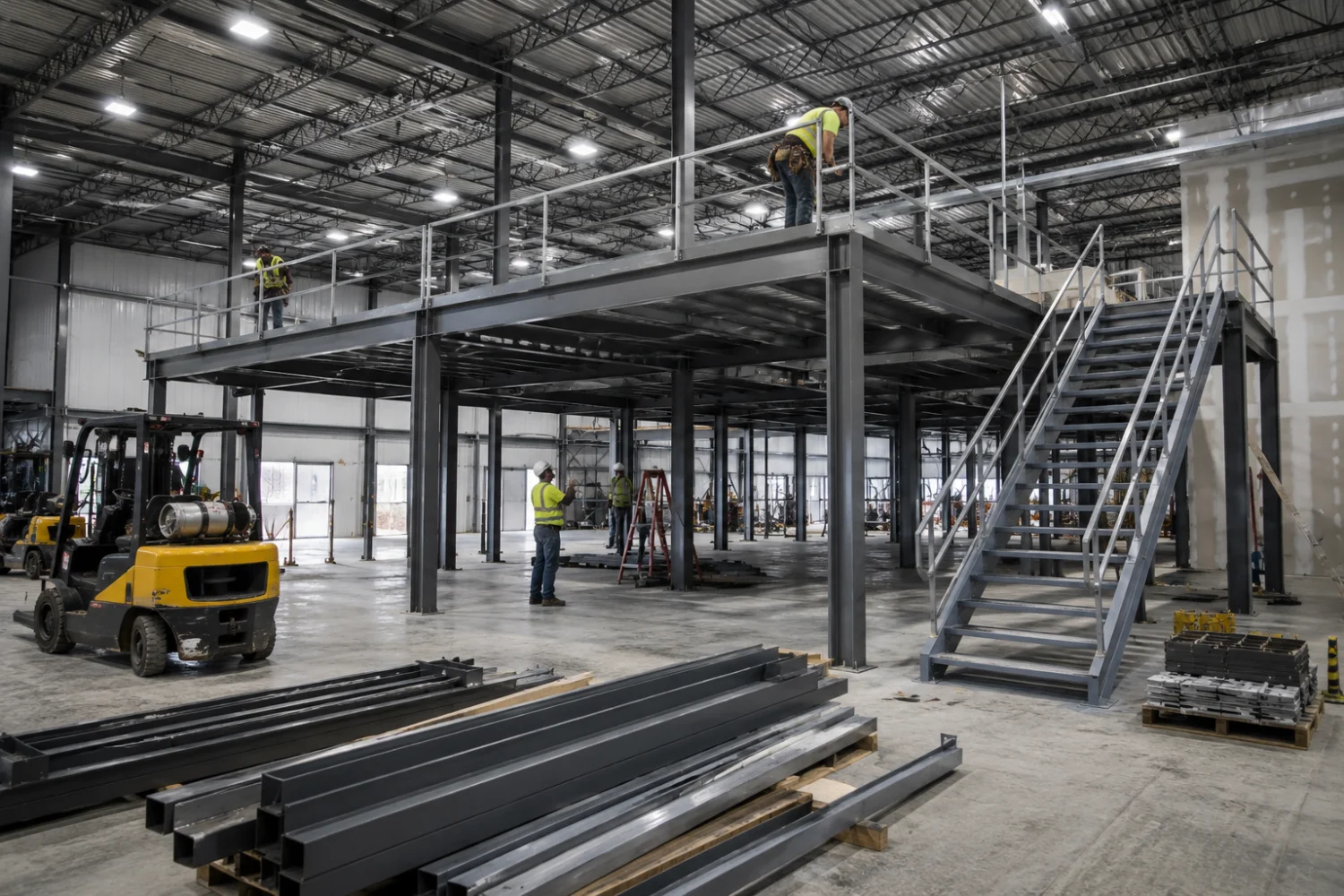
Instead of expanding the building’s footprint, modular mezzanine systems create usable square footage by utilizing vertical space. Facilities with sufficient ceiling height and appropriate structural conditions can use mezzanines for:
- Inventory and material storage
- Warehouse staging
- Offices and administrative areas
- Production support
- Light assembly
- Quality control
- Maintenance functions
Prefab mezzanine systems can provide a more contained approach to adding space within an existing facility. Rather than expanding the entire building, the project can focus on the specific area and function that requires additional capacity.
It can make sense when a business needs to:
- Increase storage capacity
- Add office or administrative space
- Create inventory staging areas
- Move support functions away from production areas
- Add production support or light assembly space
- Improve vertical space utilization
- Preserve valuable floor space for core operations
When a Building Addition Is the Better Choice
A modular mezzanine is not a substitute for every type of expansion. A building addition may be the better investment when a facility:
- Has limited vertical clearance
- Needs substantial additional floor space
- Requires space for large machinery
- Needs new loading docks or expanded shipping infrastructure
- Requires major utility expansion
- Cannot support the required structural loads
- Has long-term growth plans that justify a larger footprint
Compare the Investment, Not Just the Price
1. Initial Investment
2. Time to Completion
3. Operational Disruption
4. Long-Term Flexibility
The best investment should support more than today’s needs. Leaders should consider how the facility may change as inventory, staffing, production, and workflow requirements evolve.
The smartest expansion is not always the biggest one. It is the one that delivers the capacity your operation needs with the right balance of cost, speed, and long-term value.
Frequently Asked Questions (FAQs)
Are modular mezzanine systems cheaper than building an addition?
How long does it take to install a modular mezzanine system?
How do I know if my facility is suitable for a mezzanine?
The Smarter Expansion Decision Starts with the Right Questions
Facility expansion is a major capital decision, and the lowest construction quote does not always deliver the lowest total cost. A building addition may be the right investment when an operation needs significant new floor space or infrastructure. A modular mezzanine system may offer a more efficient alternative when the goal is to increase usable capacity within an existing facility.
Jarvis Material Handling helps facility leaders make that distinction. With more than 65 years of hands-on industry experience, we look at how a solution fits the entire operation, from workflow and safety to compliance and long-term scalability. We bring the operational discipline, accountability, and precision needed to help organizations make facility investments that perform today and remain valuable as their businesses grow.